The humble community garden is one of the most underrated tools we have for building connection.
Last month, I had the honor and pleasure of attending the U.S. Chamber of Connection’s Connected Cities Conference in Seattle. It was simply extraordinary. A room full of some of the most inspired and inspiring people I’ve ever met, all gathered together to do one thing. Rebuild connection, block by block, across our country.
According to the organization’s founder, Aaron Hurst, “People talk about the crisis of connection as A problem in our country. They have it wrong. Connection is THE problem.” Yes.
So we spent time learning about the Chamber’s framework — the Six Points of Connection — explored the emotional, health, and economic impact of isolation, and brainstormed strategies to build a durable, supportive American future. Based on the Six Points framework, it turns out less than half of Americans are thriving.
Yet, throughout the conference, I was buzzing. It turned out that I was there to promote a secret strategy that is, in fact, civic infrastructure, that checked all the connection boxes. A strategy that, quite frankly, I didn’t realize was a secret.
Community Gardens.
Let me explain.
Saturday morning, 9 a.m.
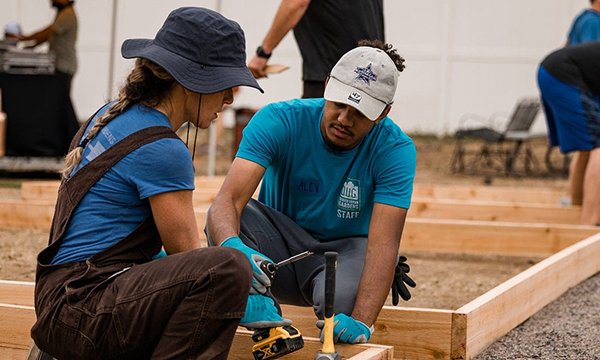
Picture a corner lot on any block in America. A 20-something tends to his herb garden. A retiree turns the compost. A teenager hauls a wheelbarrow for his first stipend. And a family new to the neighborhood plants the greens they grew up eating in their home country. Not one of these community gardeners would call what they are doing “civic infrastructure,” but that’s exactly what it is.
Community gardens are everywhere people live. With an estimated 20,000 community gardens dotted across the U.S., they support 2.4 million gardeners and produce upwards of 72 million pounds of hyper-local, nutrient-dense, culturally relevant food every year. They attract an extraordinarily vast cross-section of society and possess all of the structural characteristics of what we think of as civic infrastructure. And, they’ve been growing at a rapid clip since the 1970s. All the while, bowling leagues, lodges and labor unions — the poster children of civic infrastructure — have been eroding.
Yet, despite all this, community gardens are often overlooked as mere hobbies.
We, at the Urban Garden Project, assert that community gardens are, in fact, essential civic infrastructure for thriving cities. Indispensable tools of connection.
Loneliness is a place problem
But loneliness is also a geography crisis. When the corner store, the congregation, and the busy front porches disappear, so do our beacons, our safe harbors, and the pulse of our neighborhoods. We lose the everyday formal and casual encounters that carry us through good times and bad.
According to Seth Kaplan in Fragile Neighborhoods, connection needs somewhere to happen. Physical places. Our neighborhoods. Our blocks. Where we live, stroll, shop and celebrate. The community garden is one of the best places a community has.
Come for the tomatoes, stay for each other
Sociologists call what grows in a community garden collective efficacy: mutual trust plus a shared willingness to act for the common good. It’s a hallmark of safe, healthy neighborhoods, and one of the things fragile ones have lost.
Teig, Litt, and colleagues (Health & Place, 2009) interviewed 67 gardeners across 29 Denver gardens and found six social processes at work: connection, reciprocity, trust, shared decision-making, civic engagement, and community building. Armstrong (2000) found gardens in low-income New York neighborhoods were four times more likely to spark residents to tackle other local issues. The garden is civic boot camp. Run a meeting, settle a hose dispute, welcome a newcomer, then take those skills to the block association.
UGP board member Omar Brownson of the Los Angeles Community Garden Council calls this “the radical practice of sharing land.” In a culture that fences and sells ground, gardeners govern it together: the water, the planting, the events. That’s hyperlocal democracy in action.
The secret recipe for belonging
Then once you’re in, three things keep you there:
- An invitation. Joining anything new is scary, and fear of rejection is as human as it gets. “Join us Saturday, we need help weeding” makes it easy to say yes.
- Being needed. Belonging means knowing things won’t thrive without you. Skip a hot week and your plot wilts. Skip a work day and your fellow gardeners miss you.
- Structure. Clear roles, rules, and rhythms tell a newcomer what to do and give disagreements a fair way to get settled.
Then there’s the icing and sprinkles on the cake: A neutral, apolitical task done shoulder to shoulder, hands in the soil. Anyone of any age, income or skill level can contribute. And delicious fruits and vegetables. In a country separated by politics and screens, this is rare.
The proof is in the soil

Greening isn’t gardening, but the lesson holds: when people see care invested in a place, they come back outside. And neighbors who stay put are the raw material of every great neighborhood.
Built to last
The modern movement is the opposite. It began in the 1970s, from the ground up, by the people and for the people.
New York shows how deep those roots go. In the 1970s, residents of disinvested neighborhoods, many of them Black and Latino families, turned rubble-strewn lots into gardens. In 1998, the city moved more than 700 of these spaces toward development and soon put 114 on the auction block. Gardeners fought back, and in 2002 they won permanent protection for nearly 200 neighborhood garden sites.
Nobody fights that hard for an amenity. They fight for something that’s theirs.
A garden on every block
A place where people know your name. Where you have a job and a purpose. Where neighbors gather when the storm hits or the power goes out. That’s a resilience hub. That’s a front line against loneliness.
It’s that simple. And it’s already here.
So let’s stop overlooking it. Let’s:
- Put community gardens in every conversation about connection. Count them in our indexes. Invite gardeners onto connection councils and welcome committees.
- Plan for them. Write them into city plans and require developers to include them in master plans.
- Secure the land. Formalize land-use agreements, and move gardens into land trusts wherever we can.
- Fund them like infrastructure. Support the gardens and the organizations that give them sturdy, durable back-office support. Few investments do more good per dollar.
And for you, reading this right now: chances are there’s already a community garden in your neighborhood. Visit it. Join it. Volunteer. You’ll find strangers who become neighbors.
That’s not a hobby. That’s how a neighborhood comes back to life.
The next time someone tells you they’re there to represent community gardens, I hope you won’t give them a blank stare. I hope you’ll lean in and say, “Tell me more.”
Sources
- U.S. Surgeon General, Our Epidemic of Loneliness and Isolation (2023)
- Derek Thompson, “Why Americans Stopped Throwing Dinner Parties,” The Atlantic (2026)
- U.S. Chamber of Connection, Six Points of Connection (2026)
- Seth Kaplan, Fragile Neighborhoods: Repairing American Society, One Zip Code at a Time
- Trust for Public Land, “Here’s the Dirt on Park Trends: Community Gardens Are Growing” (2018)
- Teig et al., “Collective efficacy in Denver, Colorado,” Health & Place (2009)
- Armstrong (2000); Litt et al. (2011); Been & Voicu (2006), via NC Community Gardens research summary
- Omar Brownson / Los Angeles Community Garden Council, “The Radical Practice of Sharing Land”
- American Press Institute (2025) Collective Wisdom: Engaging Neighborhoods
- The Urban Garden Project, 9 Factors to Thrive
- Branas et al., vacant lot restoration trial, PNAS (2018)
- Litt et al., community gardening trial with Denver Urban Gardens, Lancet Planetary Health (2023)
- NYC Community Garden Coalition, history of New York’s community gardens